Friday, January 31, 2025

1744 BATTLE OF MADONNA DELL'OLMO - SPANISH REGIMENTS

I rewieved the uniforms of the Spanish Regiments present at the Battle of Madonna dell'Olmo of my previous post, where I found an error: I considered as present the Irish Regiment Hibernia; actually it was a sort of Iberia, i.e. Espana. 

I went to check on the Kronoskaf site for the Spanish troops in SYW and I found out that in the WAS the Irish Regiment Hibernia fought at the defense of Neapoles in 1744 and hence it is impossible its presence the same year at the Battle of Madonna dell'Olmo.

At the contrary, the same source states that the Espana Regiment passed the Alps in 1744. Also my misunderstanig was due to a bad reading of a map of the battle, where the name of the Regiment was faded.

So finally I could draw in their completeness the Spanish Regiments that fought at the Battle of Madonna dell'Olmo.


Note to distiguish the Regiments:

Aside the Swiss Jung Reding Regiment, that wore a blue uniform, all the other Spanish Regiment, since 1717 wore white uniforms. To distiguish between them there were different elements: the ribbon of the tricorne and buttons (always of the same colour) were silver of gold. Some units had the trousers of the lining colour, others in white. Other units had the vest in colour, other in white.

I am pretty sure there were difference in the position of the pockets (bewteen totally similar regiments) but at the state I was not able to find any detail (while for Piedmontese units I will have no problem for this).

Also important to point out that some regiment were regular and hence they had a collar of the same lining colours, while others were provincials ("Regimentos Proviciales") and they wore a black tie, with white unifors as per Regulation dating 1734.

In the figure above it is hence possible to distinguish as provincial the Cordoba and Grenada Regiments.

The Regimentos Provincilaes were 17: Jean, Badajoz, Sevilla, Burgos, Lugo, GRANADA, Leon, Oviedo, CORDOBA, Trujillo, Santander, Orense, Santiago, Pontevedra, Tuya and Betanzos.

Some doubts arose about the nuances of the blue for the Toledo Regiment. In fact, from the Spanish sources was "azul" i.e. blue. Then I found this pictures of this regiment


and I tried to reproduce the same "blue" as here:


but getting back to Kronoskaf it has the same picture but with a different (and normal) blue


So I kept the former blue colour.

Another doubt was the lining fo the Cordoba Regiment. The sources dating after the realm of Felipe V gives red lining while before green. So I kept the green lining. Moreover for the regiment Espana there were sources saying light green (around 1750) while before just bare green. So I did it in a sort of green not too dark, not too light.


There is finally a very interesting adding: while I was preparing my OOB I found that defending the Church of Madonna dell'Olmo there were 3 Battallones Provinciales. I thought they were simply grenadiers taken from regiments present at the battle, (even though the numbers of Provicial Regiments were too low to form 3 battalions) but then I found about this units: it was a special unit of 3 batallions of combined grenadiers taken from militia units; so not belonging to any specific regiment (line or provincial) and hence dressed all the same in a very characteristic purple faced colour. 


Grenadero Provincial 1744


This uniform was taken from this (please not the wrong colour for the Rgt Cordoba)
Nontheless for the Granaderos Provinciale it is plenty of info and well detailled. This trigged my curiosity also because it gives the correct number of the Battalions but what astonish me is that they were dressed all the same way.
I asked some help in The Miniatures Pages and mostly they said that during the Napoleonic period they exsisted, while doubts arose for this period.


Finally I find this in the Book Carlo Emanuele III di Savoia a difesa delle Alpi nella campagna del 1744, Studio storico militare written by Colonel Carlo Buffa di Perrero in the year 1887, where he pointed out the existence of 3 Battalions of Provincial Grenadiers, number that perfectly matches with all the numbers I saw, regarding these troops.


This info was taken from a note in the Turin Archive where it was pointed out all the French and Spanish troops that crossed the Alps at the beginning of the 1744 Campaign.


Wednesday, January 29, 2025

1744 BATTLE OF MADONNA DELL'OLMO. ORDER OF BATTLE FRENCH/SPANISH ARMY

My previous post was a little bit done in a hurry. I had since then time to reflect and to fix the OOB. It was not an easy task above all for the Army of the Two Crowns (France and Spain), but thanks to Spanish sources I menaged to fill the gaps.

Here the results:


3 Btg Combined Grenadiers (Sp)
1 Btg Reg. Codoba (Sp)
1 Coy Spanish Husares (Sp)

1 Btg Reg. Cordoba (Sp)
2 Btg Reg. Saboya (Sp)
2 Btg Reg Vitoria (Sp)
2 Btg Reg. Asturias (Sp)
2 Btg Reg Toledo (Sp)

3 Btg Reg. Lyonnais (Fr)
1 Btg Reg Beauce (Fr)

4 Sqd Dragons Languedoc (Fr)
1 Sqd Grenaderso a Caballo (Sp)

4 Sqd Dragones Lusitania (Sp)
Sqd Dragones Numancia (Sp)
2 Sqd Dragones Edimburgo (Sp)

3 Btg Reg. Poitou (Fr)
1 Btg Jung-Reding (Sp)
1 Btg Combined Grenadiers (Sp)
2 Btg Reg. Anjou (Fr)

4 Sqd Dragones Pavia (Sp) on foot
3 Sqd Dragones Frisia (Sp) on foot

1 Btg Reg Grenada (Sp)
2 Btg Reg Navarra (Sp)
2 Btg Reg Mallorca (Sp)
1 Btg Reg Espana (Sp) (aka Hiberia)

5 Sqd Dragons de la Reine (Fr)
3 Sqd Cav Conti (Fr)

1 Btg Gardes Lorraines (Fr)
1 Btg Conti (Fr)
1 Btg Brie (Fr)
1 Btg Stainville (Fr)
1 Btg Conti (Fr)

4 Sqd Cav Real Piemont (Fr)
2 Sqd Cav Commisaire General (Fr)
2 Sqd Cav Charost (Fr)

3 Sqd Cav del Principe (Sp)
3 Sqd Cav Sevilla (Sp)
3 Sqd Cav Calatrava (Sp)

3 Sqd Cav  Guardias del Corps (Sp)
3 Sqd Cav Montesa (Sp)
1 Sqd Carabineros Reales

1 Btg Foix (Fr)
1 Btg Flandes (Fr) 

1 Btg Vivarais (Fr)

1 Btg Ile de France (Fr)

1 Btg Quercy (Fr)


The main info are from El Ejercito Espanol tra la Guerra di Succession (II) of Guerreros y Battallas with some other info, above all the map of the Battle of Madonna dell'Olmo here:


From this map (a part of it) I am also going to prepare my map, with details of troops and their array. It will be the first one to be detailled in this way.


1744 BATTLE OF MADONNA DELL'OLMO: REGIMENT MALLORCA STANDARDS

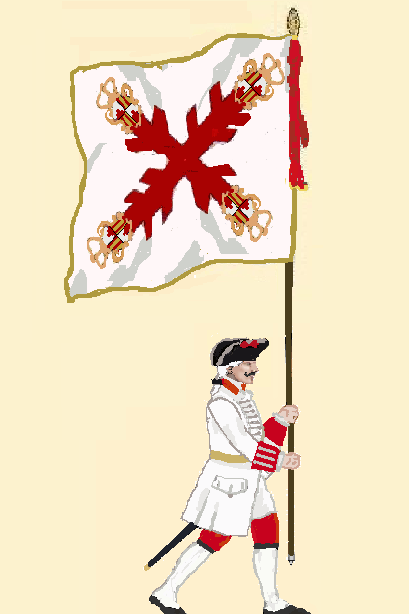
 After a little researches I came up with my 2 templates representing the Alferez (stardard bearer) of the Mallorca Regiment.


For this purpouse I used some info I went through. Specifically, I found the Flag Colonela of an Infantry Regiment in 1750:


I changed hence the coat of arms to that of Felipe V of Spain and obtained the Colonela:


On the corners accoding to the painting of the epoch there is the coat of arm of the Mallorca Regiment. I found it in an old picture and I reproduced it in the 4 corners.


and from this I reproduced the Ordinance Standard of the Regiment (here under)


It is important to note that every Regiment had just 1 Bandera Coronela, while all the rest (3 per battalion) were Banderas Sencillas.
While after the Reign of Felipe V also the Banderas Coronelas carried the Burgondy Cross, and the Coat of Arms of the King, during the Reing of Felipe V they carried just the Coat of Arms with at the corners the symbol of the town/province.


And in fact, I found on the book of the serie Guerreros Battallas number 134 this image (exactly!) of the Mallorca Regiment! So I had to modify my previous template:


From this magnificent figure I realized mine:


                                            Regiment Mallorca 1744 Bandera Coronela


and  after some more researches I mended my previous template:


Regiment Mallorca 1744 Bandera Sencilla


Here another version of the Bandera Coronela


Wednesday, January 22, 2025

1744 BATTLE OF MADONNA DELL'OLMO - SPANISH ARMY

 As it always happens to me, I start one project, one template and then I have to correct it. After some doubts, I thought that maybe would be better to recreate a battalion with different poses, not just marching. So I tried to draw from a picture of the fantastic First Legion Miniatures, transforming a Russian solider of SYW to a Spanish soldier at the Battle of Madonna dell'Olmo in 1744. 

I think the result is quite interesting. I will proceed with other examples

The soldier belong to the Mallorca Regiment.


Wednesday, January 8, 2025

1744 BATTLE OF MADONNA DELL'OLMO (AKA DI CUNEO) WAR OF AUSTRIAN SUCCESSION

The new year has just begun, and I would like to celebrate it by returning to an old project of mine—one of those projects which, like many others, may never truly be completed. I am well aware of this, but I also know that I will continue working on it nonetheless.

The Battle of Madonna dell’Olmo was fought near the town of Cuneo, in south-western Piedmont, an area to which I feel deeply connected, as I live between the present-day provinces of Turin and Cuneo. This battle also has a particular significance for me because it involved the Piedmontese Army to a considerable extent. For this reason, I feel almost duty-bound to pay tribute to my ancestors, who fought with such courage on that battlefield.

The uniforms of this period are also particularly attractive. Compared with those of the War of the Spanish Succession, military dress had developed into a much more refined and sophisticated system. Moreover, a considerable amount of reliable information survives concerning the actual uniforms worn at the time, especially by Piedmontese, French and Austrian units.

The Spanish Army that fought at Madonna dell’Olmo, however, has been largely neglected. Reconstructing its order of battle and identifying the uniforms worn by its regiments proved to be a considerable challenge. Nevertheless, I was eventually able to gather enough information to produce a reasonably accurate reconstruction, and I would now like to share the results.

The following Spanish regiments took part in the Battle of Madonna dell’Olmo:

Regimiento Toledo
Regimiento Vitoria
Regimiento Asturias
Regimiento Navarra
Regimiento Mallorca
Regimiento Córdoba (Provincial)
Regimiento Granada (Provincial)
Regimiento Jung Reding (Swiss)
Regimiento Hibernia (Irish)

After the military reforms introduced under Philip V, particularly from 1707 onwards, Spanish infantry generally wore white coats, with either gold or silver buttons and a variety of distinctions in the colour of the waistcoat, breeches, cuffs and other details.

The provincial regiments could also be distinguished by the small black neckcloth worn around the neck instead of a conventional collar.

Foreign regiments serving the Spanish Crown retained uniforms associated with their own national traditions: the Irish wore red, while the Swiss regiments in Spanish service wore blue.

I can therefore now present my reconstruction of the Spanish infantry that fought at the Battle of Madonna dell’Olmo on 30 September 1744.


                                                                 Regimiento Saboya


                                                                Regimiento Vitoria


Regimiento Mallorca


Regimiento Navarra


                                                                Regimiento Asturias


Regimiento Toledo


REGIMIENTOS PROVICIALES

Regimiento Cordoba


Regimiento Granada


REGIMIENTO IRLANDES (IRISH)

Regimiento Hibernia


REGIMIENTO SUISO (SWITZERLAND)


Regimiento Jung Reding


Obviously every Regiment had also his company of Grenadiers (Granaderos): here an example.


Grenadier of the Mallorca Regiment


Once I prepared all the templates, I found some mistakes (fig 1) to be re-drawn (fig 2): the tail should be longer (I took as example a template of the SYW) and the pattes de paramants, bigger than it was. I did better the vest and I rounded the tail. This are tiny differences between a uniform of the War of Austrian Succession and one of the SWY; the first still had influnce of the military fashion of the beginning of the century, while the other (even though around 15 years later) had the exeprience of that war to increase in confort.


After this template, I was not convinced: the rifle seemed to me too tall and not in the correct way. So I changed to this: