For the first time I tried to make a corpsman (eith injured soldier). I took as basis Arfix

and in particular the unit of corpsmen:<

From this I did my template:
%20barelliere%202.png)
My project about the German Army in its first period of fighting (1914/1915) went on. More thant Tannenberg, I am fascinated by the following battle of Lodz, on middle November 1914, until 5th December 1914. This battle battle started in a still acceptable weather, just to turn rapidly bad.
Hence I wanted to recreate a mixture of uniforms: some men fighting, still have the normal uniform, while other already wears the coat and gloves. Some are just in the middle of this transformation, evident from the colour of the headgear.
I really liked to add the winter details to the normal uniforms, and, as fas as I remember, there are not examples of figures in this dress.
%20trasformazione.png)
%20trasformazione%201.png)
My temporary limit as history lover is 1914 (maybe February 1915); over this period for me there is no more interest, because it is too close to the current epoch with all its awful aspects.
During my researches for a template of a German soldier of the summer 1914 I had a lot of difficulties to find good miniatures and poses. So I had to invent some different ways to achieve my goal.
I thought about armies that had a sort of similar uniform of that of the German Army in 1914 and my attention went - obviously - to the Prussian Army in 1870. From some figures of that Army (of that army there are much more examples) I did my template:

 |
| Figure Nr. 2 |
I decided in the last case to change the head of the German shooter (figure nr. 3):
 |
| Figure Nr. 3 |
 |
| Figure Nr 4 |
It is also interesting to note the increase in details if I just show here a previous template I did in 2015 (Figure Nr. 5)
 |
| Figure Nr. 5 |
Futhermore, to increase the different poses, I took samples from papersoldiers for Zulu wars and I transformed them:
.png)
%20medio.png)
After a little of bit of misunderstanding and a lot of help from the good fellows of TMP I went back and I finally understood how an Austrian Battalion in 1866 was actually deployed for its Stosstaktik.
I went back to a 3 divisions formations, each division on 2 companies (one after the other) and each division deployed on 3 ranks of about 55 men each.
So pratically an Austrian Battalion could act through its 3 divisions, that could split or adapt to the surrounding terrein.


I come bacjk to this post to complete my work and to prepare a future pubblication of all the material I found in an Italian/English version.
Just as fresh up, here the Batailles that fought at that battle.
 |
| Map nr. 10 - Christian Cavalry formation at the 3rd Battle of Ramla |
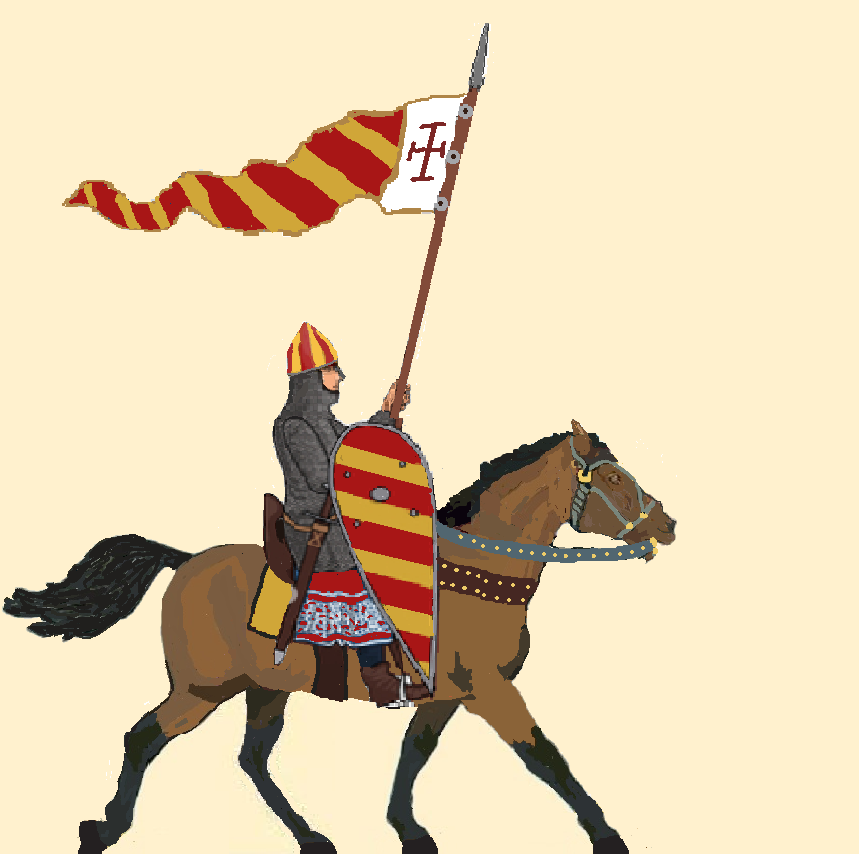
THE CRUSADERS' STANDARDS OF THE "BATAILLE"

%202024.png) |
| Principate of Galilea 1105 |

 |
| Lordship of Chaypha (Haifa) |
BATAILLE DE GUNFRIEDUS DE TURRIS DAVID
This was the usual appellative given to the Chatelain of Jerusalem aka of the Tower of David.
His family's name was de Cavis
It is possible to make a standard similar to that of the Kingdom of Jerusalem, with little modifications:
 |
| Standard of the Chatelain Turris David BATAILLE OF HUGO DE SANCTO ABRAHAM It is quite difficult to understand this Hugo de Sancto Abraham. I found a document date 1104 where it is quoted this Hugo as a witness of an agreement between the King and the Genoese people. Jerusalem. Baldwin, rex Iudee et Ierusalem ac defensor sanctissimi Sepulcri domini nostri Ihesu Christi, gives the church of St Laurence of Genoa plateae in Jerusalem and Jaffa; a third part of Asur/Arciuf and Caesarea, with a third part of their territories, which extend for a league, together with a casale in each; a third part of Acre, with a third part of the city territory which extends for a league; 300 besants a year in exchange for other casalia; a third part of every city and its territory which the Genoese help to take with 50 or more soldiers, together with a casale; and a third part of Old Cairo [Babilon] with three of the better casalia of their choice. Baldwin swears never to harm or imprison Genoese, who will pay no commercium; neither will merchants from Savona, Noli or Albenga or the family of Gandulfus Pisanus filius Fiopie/Tropię. Baldwin renounces rights on the goods of Genoese who die in his dominions and on shipwreck. Witnesses: Ugo de Tabaria; Ugo de Sancto Abraham; Geruasius dapifer; Galterius Machomet; Fredericus de Corbolio; Pesellus vicecomes; Golfridus de Turre Dauid; Gotman. This text shows this Hugo together with the major Lords of the Kingdom. Later on, changing name, but with the same title other Lords witnessed the oath of the King. In one document, it is called - very important - "Prior name de Sancto Abraham"; this means it should be a sort of first Cavalry Order or a "Confraternita" of fighting people that did a sort of sacred oath. It is know that already in 1099 Goffredus de Bouillon organized Cavalry Orders to defend the pilgrims. In 1099 the Crusaders occupied Hebron and with Hebron considered the putative burial place of Abraham; it is then evident that this Order was accomplishing a service to the putative tumb of the Patriarch, as well as the Order of Saint Sepulcre in Jerusalem. It is important to note that the latter had a force of around 50 Knights; it is possible that this Order had the same force or a little smaller plus around 60 sergeants. From this knowledge is possible hence to reproduce a standard for this Battaille that fought at the Battle of Ramla in 1105.  Standard of Hugue de Sancto Abraham BATAILLE OF EUSTACHIUS I DE GRANIER, LORD OF CAESAREA There are a lot of sources about this commander, Lord of Casesarea. There are some hypothesis about his origins, whether Flamish of Frank, from Aquitaine. I think there is no doubt that he was from the Flamish Duchy, considering that the rest of the other Commanders of the Battailles at the Battle of Ramla were all Flemish, as Baldovinus, so there was a tight bond between this Lords and their King. He became Lord of Caesarea in 1101 and Lord of Sidon in 1110. This gives the idea how much the King trusted him. In the year 1123 he was elected constable and bailiff of Jerusalem and during the captivity of King Baldwin II he defeated the Fatimi Army at the Battle of Yibneh, near Ibelin The fact that he was from diocese of Thérouanne, and that on a seal of one his descendents is depicted a sort of coat of arms with parallel stripes, allows to reproduce his coat of arms with a good degree of certitude as follows. Some sources say in particular that besides belonging to this Diocese of Thérouanne he was originary from the town of Beaurainville (located in that Diocese); here coat of arms of the Town of Beuarainville nowadays: it is intersting to note the square with stripes, exactly like in the coin of that period. Considering also that in the epoch the heraldry was still very simple, it is evident that the eligible example for his coat of arms (or a sort of) at the Third Battle of Ramla could be like in the square (top left):  From this coat of arms is possilbe to see (top left) the (probably) original one; hence the standard:  Eustace Granied's place of origin is written in a poem Versus de viris illustribus diocesis Tarvanensis qui in sacra fuere expeditione (translation Vers about illustrious men of the Diocese ot Thérouanne who took part in the Holy Expedition); in this poem Eustace I de Grenier is cited among the knights of the Diocese of Thérouanne who accompanied Baldwin of Boulogne, fhe future King of Jerusalem. He is defined as "notus miles, cognomine Gernirs" i.e. "famous knight, with family name Gernirs" (actually his name was written in very different ways: Garnerius, Granerius, Granarius). Guillaume de Tyre quotes him as one of the Barons of Baldwin of Boulogne. That means that from Flander this Knight was a vassal of Balwin What can be said by sure is that he was Flamish, he came together with his Lord, Baldovinus de Boulogne and he was always very trustfull towards his King and a very gifted warrior. BATAILLE OF PISELLUS DE TOURNAI Also this Lord is quoted in different sources, and like the other is a Flamish.  He was apponted Vicompte de Jerusalem, an office created soon after the end of the First Crusade, and Pisellus was the first to be appointed (1104); His flag represents the white of the Flag of Jerusalem, cosidering that in 1105 he was Vicompte de Jerusalem and the red as first colour/banner of the Town of Tournai in Flanders. Also in this case, we have confirm he was Flamish, like all the others Commanders and Lord at the Battle. BATAILLE OF BALDUVINUS DE HASTRUT (CASTELLO FIANDRIAE) |


While it was easy to understand how a SYW battalion was attacking or a Napoleonic Regiment, I found quite challeging to understand how a battallion or a brigade actually was deployed in 1866.
For this purpose I tried to simulate some different arrays, hoping to be clear:


As it is well known, this regiment fought at the Battle of Custoza on 25th July 1866 and precisely under the command of Colonnel Maximilian von (Ritter) von Rodakowski charged furiously the famous "Quadrato di Villafranca" the Infantry square of Villafranca, arrayerd by the 49th Italian Line Infatry, inside which the Prince Crown Umberto di Savoia (future King Umberto I) recovered from the attack .A lot of painting from both sides represent this episode of the Battle, as well as I would love to do and hence I prepared the Italian Infatry (see my previous posts).

This painting in any case in very intersting because it shows uniforms of the 13th Uhlanen Regiment, above all in the foreground the trumpeter (with white leather). It is also interesting to note that the painter represented the Regiment mostly armed with swords instead of lances. Starting from 1860 the carabine was withdrawn, and they were armed with lances (and swords).
This regiment was raised in 1860 as Freiwilligen-Uhlanen-Regiment (volunteers Uhlanen Regiment) but was voluteer just in title; in fact its men were drwn from a single division of each of the regular Uhlan Regiments, nr. 1,2, 8 and 10 from Uhlans with at least 10 years of service.
In 1862 this regiment started to wear the blue/azure new uniform, abandoning the green regular one. The headgear was a low peakless cap called Tatarka with a lower portion of black lamswool and a square topped final part with a feather on the top of it (left side). Its size was reduced from 1863.
The overcoat (called "Uhlanka" was light blue, with a single row of 10 yellw buttons, bright red cuffs and badges; the coat was dark blue.
They were armed with a lance without pennon, a pistol, and a light sabre.
 |
| Picture nr. 2 |
This unit was on 6 squadrons with 850 men and 775 horses (field strength), meaning that in wartime every suadron could rank on the battlefield 130 men.
I also found this (naif) painting representing always that episode (picture 3)
 |
| Picture nr. 3 |
Futher problem to understand was he saddle. In this paintings it seems quite simple (Black or brown) and little; from the following picture (nr. 4) it seems is was red, but I doubt in the field it was in this way
 |
| Picture 4 |
Nontheless it the following (Italian) painting of Raffaele Pontremoli (picture nr. 5) the saddle are very well represented (and there is some red) (see also the detail) with a sort of light white under saddle
 |
| Picture 5 |

I went on with my reasearches and I found this very clear image (in this case the saddle is all black!)


| Brigade Pulz | Oberst Ludwig Pulz |
| Uhl.-Rgt. Graf Trani Nr.13, 1., 2., 5., 6. Escadrons | Oberst Maximilian Ritter von Rodakowsky |
| Husz.-Rgt. Fürst Liechtenstein Nr.13, 3., 4., 5., 6. Escadrons | Oberst Ladislaus Graf Szápáry |
| Husz.Rgt. Kaiser Franz Josef Nr.1, 1., 3., 4., 5. Escadrons | Oberst Alexander Rigyitsky de Skrbestje |
| 4pfd. Cavallerie-Batterie Nr.8/V | |
Brigade Bujanovics | Oberst August Bujanovics von Agg-Telek |
| Uhl.-Rgt. Sicilien Nr.12, 1., 2. Escadrons | Oberst Friedrich von Berres |
| Husz.-Rgt. Prinz Württemberg Nr.11, 2., 5., 6. Escadrons | Oberst Joseph Török von Erdöd |
| Husz.Rgt. Prinz Carl von Bayern Nr.3, 1., 3., 4.. Escadrons | Oberst Julius Gradwohl |
| 4pfd. Cavallerie-Batterie Nr.8/V |

