Tuesday, April 5, 2022

AUSTRIA 1848 UHLAN REGIMENTS

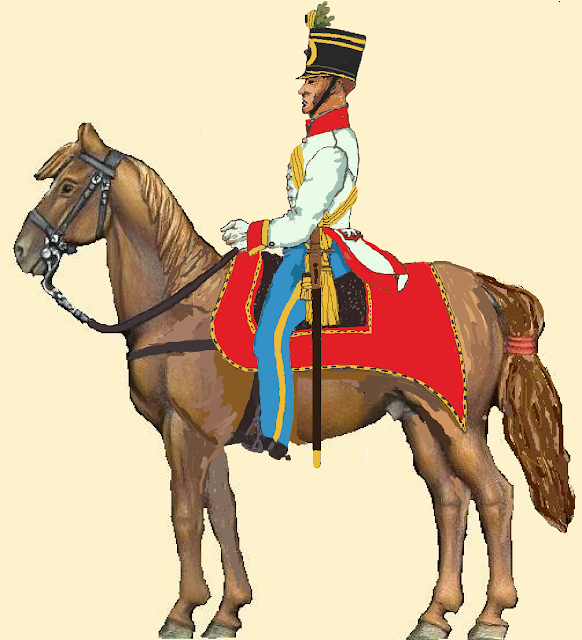
 The uniform of the Uhlans in the Austrian Army in 1848 was - as usual - very similar to that of the Napoleonic Period. 

The Austrian Army in 1848 had 4 Uhlan Regiments; in Italy, there were present the 3rd Uhlan Regiment Erzherzog Karl Ludwig and the 4th Regiment Kaiser Ferdinand. This units were usualy raised in the Polish and Galician parts of Empire, following the traditions of these countries for fierce cavaliers.

The tactical unit was the "Division", i.e.  2 squadrons put together, every squadron had 180 men. Every Regiment of Uhlans had 4 Divisionen for hence 8 squadrons, around 1.440 men/regiment. Moreover there was the General Staff of the Regiment.

Each squadron was itself split into 2 Wings (Flugel) each of which was on 2 Pelotons. So every peloton had 45 men. During the campaign 1848/49 every regiment was reinforced by 300 new recrtuits, pratically raising the number of a regiment up to 1.800 men.

Just 16 men per squadron had a carabine the rest with spear.

The uniform was under the influence of the Polish style. So they wore a Czapka (typical square headgear), that was of different colours to distinguish each regiment.

So, for the Campaign in Italy they wore

- 3rd Uhlan Regiment Erzherzog Karl Ludwig: RED Czapka

4th Regiment Kaiser Ferdinand: WHITE Czapka

The rest of the unifor was identical for all regiments of Uhlan, as well as the saddle. 

So here below 

the 3rd Uhlan Regiment Erzherzog Karl Ludwig (and Graf von Gruenne)


and the 4th Regiment Kaiser Ferdinand (then Kaiser Franz-Joseph)

This Regiment fought in 1848 in Italy and in 1849 in Hungary.

(Just as a note, this template is a transformation from this one:)


As said, 16 men per squadron had a carabine; here the template:


The NCO of the Uhlans were distinguishable for 3 elements:


Hera bottom a NCO with modified horse's position and colours


and a Lieutenant


Details:


While on the Hungarian front was fighting the first Uhlan Regiment Herzog Sachsen-Coburg-Gotha (yellow czapka)


Austria 1848 - Regiment Uhlans Nr. 1 
"Graf Civalart"

One of the problem I would like to solve is the "name" given to this Regiment in the 1848 war. So I found all the Inhaber (owners) of this Regiment. In 1848 it was called 1ste Uhlanen-Regiment "Graf von Civalart".
Here the complete list. He fought in Hungary and not on the Italian front.

  • 1792 Feldmarschalleutenant Johann von Mészáros (Ulanen-Regiment Mészáros)
  • 1797 General der Kavallerie Graf von Merveldt (Ulanen-Regiment Graf Merveldt)
  • 1815 General der Kavallerie Ernst Herzog Sachsen - Coburg - Gotha
  • 1844 General der Kavallerie Carl Graf von Civalart
  • 1865 General der Kavallerie Carl Graf von Grünne
  • 1884–85 unbesetzt
  • 1885 Feldmarschalleutnant Kronprinz-Erzherzog Rudolf
  • 1889–94 unbesetzt
  • 1894 Feldmarschalleutnant Erzherzog Otto
  • 1906 General der Kavallerie Ritter von Brudermann


Austria 1848 - Regiment Uhlans Nr. 1 
"Freiherr von Hammerstein-Equord"


  • 1798–1800 none
  • 1800–1820 Feldmarschall Karl Philipp Fürst zu Schwarzenberg
  • 1820–1822 none
  • 1822 Feldmarschalleutenant  von Sachsen - Coburg Saalfeld Kohàry
  • 1828 Feldmarschalleutnant Franz Freiherr von Vlasits
  • 1840 General der Kavalerie Freiherr von Hammerstein-Equord
  • 1861 Feldmarschalleutnant Franz Ritter von Wallyemare
  • 1866 - 87 Feldmarschalleutnant Carl Zaitsek von Egbell


This Regiment fought in 1848-1849 in Hungary.


Saturday, April 2, 2022

WARGAME RULES "SINE ALEA" - FIRING RATE & LOSSES

It is time to have an idea how to wargame avoiding dice, just with a probabilistic rate, considering the high number of figures at disposal. One of the flaws of wargaming is that at the end is like playing chess ... with dice!

So here we start: 


Number of firgures: 81 (to be used for moral; nex time)

Number of firing figures: 72 (the rest 3 officers and 6 drummers) 

FIRST RULE: the firing number is given just by men with a rifle in hand. just the first 3 rows can be included in this calculation (further rows, like 4th or 5th and so on do not count). In this case there are just 3 rows and so all are included.

SECOND RULE: the firing number gives a percentage of losses depending on the distance of impact of the bullet on the adversary, according to the following (very semplified) scheme 

Type of Infantry

% Loss between   35 – 80 m

%Loss between   80 – 110 m.

% Loss between  less than 35 m.


Normal

6%

3%

9%


Veterans

7%

5%

12%


Elite

8%

7%

15%


Mimitia

3%

1%

5%


 Adding smoke to show that the unit in that turn (2 minute in reality) fired


In our case, considering this unit as "normal" infantry, it gives between 35-80 cm from the enemy losses for 6%, i.e. 4,86 adversary eliminated, that must be reduced to the inferior number, so 4 losses. (and until the enemy remains in that range and the unit has more or less the same number of men it gives the same losses, 4 enemy eliminated).

SECOND TURN


For instance, in the following turn the unit is hardly hit by a cannon shot + 4 men killed. The cannon shot caused 6 men down (invisible in the picture above). So the firing number reduced to 66 firing men, giving 3,96 losses, i.e, 3 losses in total.

Friday, March 11, 2022

AUSTRIA 1848 - SUPERIOR OFFICERS

Going on with my researches on the uniform of the Austrian Army in 1848 and thank to "La Spada di Radezky" book, I also represented the Colonel of the Regiment Nr. 45 "Erzherzog Sigismund".


Colonel of the Regiment Nr. 45 "Erzherzog Sigismund"


To note: the superior officers wore cocked had with green leaves of maple, as all the Army. The saddle is much more decorated and the golden and black sash is on the  waist. The ranking is given by the 3 golden lines on the collar (2 for the Lieutenent Colonel, 1 for Major, see further templates)

                                            Major of the Regiment Nr. 45 "Erzherzog Sigismund"


 Lieutenent Colonel of the Regiment Nr. 45 "Erzherzog Sigismund"


Then you can wonder I will this template appear in a real wargame battle; here we have an example:


AUSTRIA 1848 - GENERALSTAB OFFICERS ERRATA CORRIGE

 As usual, when I am in a hurry I do mistakes. So the First Lieutenant in my previous blog had some details totally wrong, and in particular:

1) The collar of the Subaltern Officers distinguished the Second Lieutenant from the First Lieutenant (that wore by the way the same ribbons on the shako) by having 2 (First Lieutenant) or 1 (second Lieutenant) golden lines.

2) The pattes-des-parament did not have any gold edge.

So I modified the previous template. Here the new corrected one with the details corrected.


Imperial Austria - 1848 
First Lieutenant detached to the General Staff (corrected version)
Regiment Nr. 45 "Erzherzog Sigismund"
Copyright Michele L. SAVASTA FIORE


The Second Lieutenant had just 1 golden line on the collar:

Imperial Austria - 1848 
Second Lieutenant detached to the General Staff
Regiment Nr. 45 "Erzherzog Sigismund"
Copyright Michele L. SAVASTA FIORE


Finally, as last of the subaltern Officers, a Captain; he had a taller golden ribbon on the shako, plus 3 golden line on the collar.


Imperial Austria - 1848 
Captain detached to the General Staff 
Regiment Nr. 45 "Erzherzog Sigismund"
Copyright Michele L. SAVASTA FIORE


Thursday, March 10, 2022

AUSTRIA 1848 - GENERALSTAB - OFFICERS

 Thanks to the super detailled book "La Spada di Radezky" I was finally able also to increase my papersoldiers with 3 examples of the Generalstab (General Staff).


From "La Spada di Radezky"

From this image I prepared my model. I changed somehow the colours and added the horse. I changed also the complexion. The Subaltern Officers did not ride a horse, except if they were detached to the General Staff of the Regiment, like here. In this case, they wore the gold and black sash crossbody.


1848 First Lieutenant - Generalstab of the 45 Regiment "Erzherzog Sigismund"


Friday, January 21, 2022

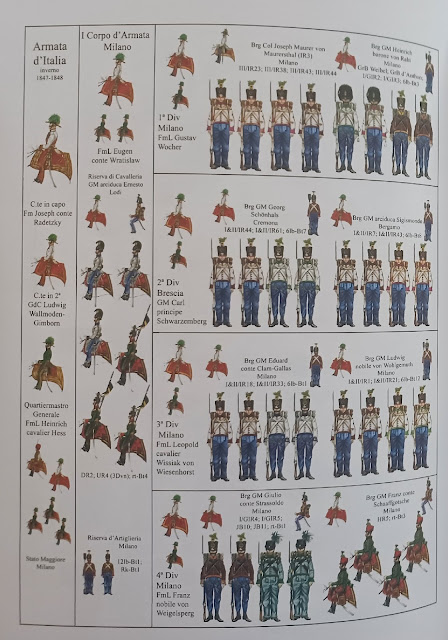
REVIEW OF A BOOK Nr. 1 "LA SPADA DI RADETZKY"

I would like to start here, besides my papersoldiers, also a sort of review concerning the books I am going to buy.

I have the pleasure to start with "LA SPADA DI RADETZKY" (means "Radetzky's sword"), Author Massimo Zoppi, with plates of Ilario Bailot, published by Itinera Progetti of Bassano del Grappa in 2011. 

I am very glad to start with this book (180 mages) written totally in Italian that represents the best book - at least under a profile of uniforms for the Imperial Army in the period 1836 - 1849. I ha happy because it represents a far better and more precise book than - for example Osprey - with super detailled uniforms, and detailled explanations.


This is a perfect example how Italians are increasing a lot in a field that is usually dominated by English speaking authors. Bravi!


The book is divided in 5 chapters (180 pages) + 68 Unifomors tables, that cover perfectly all the details of the Imperial Army.

Thanks to this super book I was able to correct my Artillery Train and switch the distinctive colours from red to the correct blue, cancelling the red line on the trousers.


Thanks to this, I corrected my plates and added also the Artillery crew on the limber of the cannon.

Copyright Michele L. SAVASTA FIORE


This book also provides a very detailled pattern for uniforms:


Veru (very) beautiful is also the OOB in the way the Author did:


So whoever is interested in this period, MUST have this book, usefull for both the Italian Campaing, mainly, but also - for uniforms) for the Hungarian Campaign (Szabadsàgharc).

I do pay my compliments to the Author, to the Editor and to the Artist. BRAVI!

Friday, January 14, 2022

AUSTRIA 1848 ARTILLERY. HORSE TRAIN WITH MOUNTED TROOP

 Behind this template there is a huge study in order not to fail or at least to fail the minimum; in fact there are few pictures about the  uniforms of the Artillery troops in 1848 that were mounted. I was able with some cautious observations to draw this:


Copyright Michele L. SAVASTA FIORE


Here a limbered 6pwd gun


.. and unlimbered


and with caisson


Copyright Michele L. SAVASTA FIORE

Here top the typical Austrian way of Artiellery troops on the timber

and unlimbered.

and a scenario of this:


Copyright Michele L. SAVASTA FIORE


Bottom - The same with the barrel down


Bottom - The same with the barrel down and unlimbered (Problem: how did they do with the long seat? I considered as the back part of the gun carriage was under the seat; so when it was unlimbered, the seat and the rest should have a sort of support)


Copyright Michele L. SAVASTA FIORE

Top: of this horse, I will do 2, to pull the train while in front there will be 2 of the following (note the correct colour of epaulettes and collar:


Copyright Michele L. SAVASTA FIORE


Bottom: 6 pdr cannon.