Friday, January 21, 2022

REVIEW OF A BOOK Nr. 1 "LA SPADA DI RADETZKY"

I would like to start here, besides my papersoldiers, also a sort of review concerning the books I am going to buy.

I have the pleasure to start with "LA SPADA DI RADETZKY" (means "Radetzky's sword"), Author Massimo Zoppi, with plates of Ilario Bailot, published by Itinera Progetti of Bassano del Grappa in 2011. 

I am very glad to start with this book (180 mages) written totally in Italian that represents the best book - at least under a profile of uniforms for the Imperial Army in the period 1836 - 1849. I ha happy because it represents a far better and more precise book than - for example Osprey - with super detailled uniforms, and detailled explanations.


This is a perfect example how Italians are increasing a lot in a field that is usually dominated by English speaking authors. Bravi!


The book is divided in 5 chapters (180 pages) + 68 Unifomors tables, that cover perfectly all the details of the Imperial Army.

Thanks to this super book I was able to correct my Artillery Train and switch the distinctive colours from red to the correct blue, cancelling the red line on the trousers.


Thanks to this, I corrected my plates and added also the Artillery crew on the limber of the cannon.

Copyright Michele L. SAVASTA FIORE


This book also provides a very detailled pattern for uniforms:


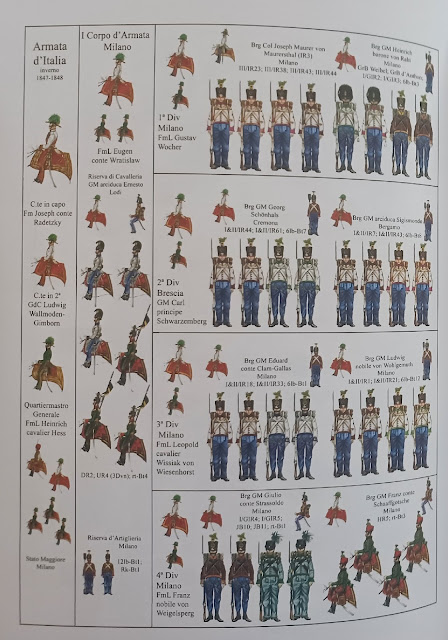
Veru (very) beautiful is also the OOB in the way the Author did:


So whoever is interested in this period, MUST have this book, usefull for both the Italian Campaing, mainly, but also - for uniforms) for the Hungarian Campaign (SzabadsĂ gharc).

I do pay my compliments to the Author, to the Editor and to the Artist. BRAVI!

Friday, January 14, 2022

AUSTRIA 1848 ARTILLERY. HORSE TRAIN WITH MOUNTED TROOP

 Behind this template there is a huge study in order not to fail or at least to fail the minimum; in fact there are few pictures about the  uniforms of the Artillery troops in 1848 that were mounted. I was able with some cautious observations to draw this:


Copyright Michele L. SAVASTA FIORE


Here a limbered 6pwd gun


.. and unlimbered


and with caisson


Copyright Michele L. SAVASTA FIORE

Here top the typical Austrian way of Artiellery troops on the timber

and unlimbered.

and a scenario of this:


Copyright Michele L. SAVASTA FIORE


Bottom - The same with the barrel down


Bottom - The same with the barrel down and unlimbered (Problem: how did they do with the long seat? I considered as the back part of the gun carriage was under the seat; so when it was unlimbered, the seat and the rest should have a sort of support)


Copyright Michele L. SAVASTA FIORE

Top: of this horse, I will do 2, to pull the train while in front there will be 2 of the following (note the correct colour of epaulettes and collar:


Copyright Michele L. SAVASTA FIORE


Bottom: 6 pdr cannon.


Thursday, December 23, 2021

1848 - AUSTRIA GUN CREW ARTILLERY

It is time to think about a little scenario. For doing this I conceived the following idea: a rearguard of Austrian Troops, i.e. a complete Artillery Company, escorted by half squadron of Radetzky Hussars just after the battle of Santa Lucia; suddently a wheel of a ammunition casson broke. The General of Brigade decided to leave a little group behind: half artillery Company, the Hussars, and a company of Jaeger with 2 pelotons of Infatry (Ferdinand Erzherzog Regiment).

This is the idea also in order to try my wargame rules without dice.

But the problem immediatly rose, about uniforms and postures of the artillery. For the uniforms it was quite simple because the Austrian Artillery used in 1848 an uniform quite identical to that of the Napoloenic period, except the had that became the Corsican, like those of the Jaeger.


1848 - Private and NCO

1848 - Artillery and Sapper


So I had to make total new posture, at the best I could. I would like to show you some transormations:


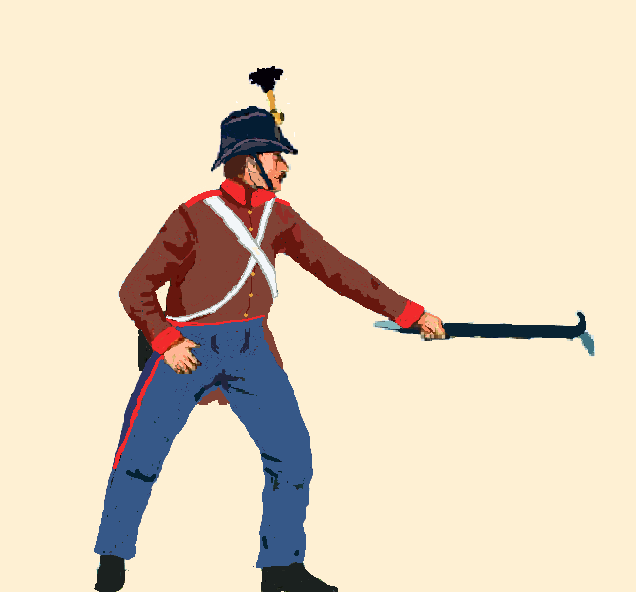
1848 Austria - Field Artillery - Loader
Copyright Michele L. SAVASTA FIORE

and again:

Copyright Michele L. SAVASTA FIORE

Copyright Michele L. SAVASTA FIORE


Copyright Michele L. SAVASTA FIORE


1848 - Austria - Private


Next problem is: how many men were around 1 gun? As far as I can understand from info from Napoleonic period, there were 7 men around (NCO/Caporal, Aimer, Firer, Ventsmen, Gunner with rammer, Ammunition handler, Loader)+ 7 private (second class gunner) to be used to move the gun and to carry ammunitions from the caissons. So around 14 men for each gun. It is possible that the aimer was a corporal and that the numer of men rose or dimished according to need. Very often the crew was aided by some infantrimen.


According to Nafizger  "Imperial Bayonets) in 1792 the Austrian Artillery Crew was as follows

GunsNCOsGunnersHandlagersHorses
foot 12pdr cannon1 NCO5106
foot 6pdr cannon1/2 NCO *584
horse 6pdr cannon1/2 NCO *6-6
foot 7pdr howitzer1/2 NCO *673
horse 7pdr howitzer1/2 NCO *5-4
reserve 10pdr howitzer1 NCO?44

* one NCO for every 2 guns


For what concerns my scenario the Brigade of Generalmajor  Erzherzog Sigismund was on: l/Szluiner Grenz Regiment # l/,2/Hohenlohe Infantry Regiment l7 3/Haugwitz Infantry Regiment 38 l/Erzherzog Sigismund Infantry Regiment #45 6pdr Foot Battery  nr.9

So what I have to reproduce is a 1 cannon of a 6 pdr Foot Battery. Considering that it does not seem that the artillery system changed from Napoleonic period to 1848, I will use this cannon with 1 NCO (they left him to organize the fixing of the cannon) 5 gunners (Caporal/Aimer, Firer, Ventsmen, Gunner with rammer,  Loader) 8 second class gunners (Handlagers).

The 6 pdrs battery (8 guns) required 8 2-wheel ammunition wagons this means that every cannon had its 2-wheel ammunition wagon.

The ammunitions field depots (called in German "Protzen") did stay 10 "Schritte" (i.e. steps, around 8 meters) away from the guns; the pack animals (4 for each gun) did stay back another 10 Schritte in the rear of the depots; the wagons of the ordinary foot-batteries were 40 Schritte away from the guns.

I also found this plate figures of Austrian Artillery in 1848.


From the 5th figure from left, top row, I did this second rank gunner, pushing the gun


Copyright Michele L. SAVASTA FIORE


And then a NCO

Copyright Michele L. SAVASTA FIORE


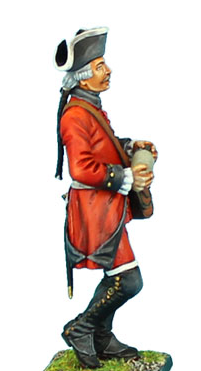
From this pose (First Legion Figures - Russian Artillery 1757): 


I did this aimer - gunner:


Copyright Michele L. SAVASTA FIORE


I did search some more pictures of a train od artillery:


Still, some pictures of a gun crew even just from 1757:


In this pictures it is possible to see: 1 NCO +  4 gunners of 1st level + 4 gunners of 2nd level + 2 grenadiers for a total of 11 men


This picture gives the idea of the proportions of the guns in comparation with crew, where the top is the 12 pdr cannon, then the 6pdr, then the howitzer (in Russian "gaubiza") and on the bottom the 3 pdr cannon.


From this I did the template of a 6pdr gun.


Friday, December 17, 2021

1887 DOGALI - THE ROYAL ITALIAN FLAG

 I always have ben fascinated by the beauty of the Royal Standard of Italy (1848 - 1946)  (at the begininng as Flag o the Kingdom of Sardinia / Piedmont.


I have now the occasion to celebrate it. This is tha War flag, i.e. with the crown over the coat of arm of the Savoy Dinasty. I think this officer will defend it till the end.


Copyright Michele L. SAVASTA FIORE


Thursday, December 16, 2021

RUSSIA 1805 - HUSSAR PAVLOGRAD REGIMENT OFFICER

 To complete the Regiment I also prepared an Offier. For him, I chose to keep the white trousers (they did like to flash even in battle) with all decors in gold)

Copyright Michele L. SAVASTA FIORE


and with sword in a different position


Copyright Michele L. SAVASTA FIORE

RUSSIA 1805 NCO HUSSAR PAVLOGRAD

I went on with my project. Now it is the time for a NCO of this regiment. In order to proceed I checked the pictures of NCO of Russian Hussars in 1805; what is sure is

a) the top of the plume was black (with an orange stripe inside)

b) the trim of pelisse was black

c) no changing in the saddle decorations

d) silver decoration over the sleeves


They are (left and right) NCO


This is NCO of the Hussars of the Garde. They have on the shako a golden band but also on sleeves, while normal Hussars seem not to have any particular decoration on the top of the shako.


I opted also to maintain for the NCO the brownish coevering of the trousers. The result of my researches and ideas is:


Russia 1805 - Hussar Regiment Pavlograd. NCO